
Columnist Yuhan Benyaminov Asks When Bukharian Weddings Stopped Sounding Bukharian


This report was translated from Russian by Bukharian Jewish Post from Yuhan Benyaminov’s column in The Bukharian Times, issue No. 1290 (Oct. 29–Nov. 4, 2026). It summarizes the columnist’s arguments; it does not endorse them.
In the Oct. 29 issue of The Bukharian Times, columnist Yuhan Benyaminov published a long essay under the headline “When a Wedding Becomes a Funeral of Culture.” The piece, addressed to the Bukharian Jewish community of America, argues that many contemporary wedding celebrations in the community have lost the language, music and ceremonial respect that once marked a Bukharian simcha, and that families increasingly treat national culture as optional décor rather than the core of the event.
What he says is missing
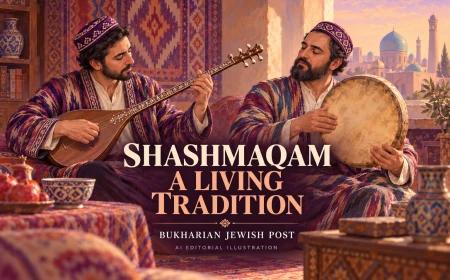
Benyaminov writes that he more and more often attends weddings at which “it is almost impossible to determine the national belonging of the bride and groom.” Expensive suits, elaborate décor and costly entertainers are present, he says, but “the main thing” — a national face — is not. He contrasts that with what he calls the traditional Bukharian Jewish wedding: a “living theater of national memory” in which the community’s language, traditional melodies, blessings by elders, poetic addresses and repertoire passed down through generations were performed by skilled artists and masters of ceremony.
The columnist does not object in principle to inviting artists of other backgrounds. Art, he writes, should not exist behind closed doors. His complaint is proportional: when Bukharian music becomes a random add-on to someone else’s repertoire, and when a host who does not know the community’s language pretends to sing in it, the celebration is no longer clearly Bukharian. “Whose culture are we celebrating — our own, or the one that is more profitable to show today?” he asks.
Parents, children and who decides the playlist
A refrain he says he hears from parents is that “this is our children’s wedding; they choose the music.” Benyaminov replies that children may choose music, language and customs only if they were first taught what those choices include. If a child grew up without the community’s language, music, history and customs, he argues, a later “refusal” of those traditions is not a fully informed choice. In his account, responsibility for the break in cultural transmission lies primarily with adults who treated family tradition as a service that could be ordered or cancelled, rather than as something to be taught.
He also criticizes emcees and performers who, in his view, replace knowledge of language and culture with stock jokes, loud catchphrases and imitation of earlier masters of the genre. Expensive sound equipment, he writes, is not the same as musical education, and a microphone does not turn ignorance into enlightenment.
Why the column landed this week
The essay appears in the same newspaper issue that advertises Lubov Pilosova’s upcoming Queens Theatre comedy “Weddings Won’t Happen! But…,” a Bukhara-on-Hudson production built around wedding humor and Bukharian family life. Read side by side, the advertisement and the column sketch two responses to the same subject: one is a stage comedy about weddings, the other is a critique of how real weddings are booked and run. Bukharian Jewish Post is reporting both as community culture news from the same issue, without taking a side in Benyaminov’s argument.
Benyaminov’s piece is an opinion column, not a news investigation. It does not name specific venues, bands or families, and it offers no survey data. What it does document is a public argument, printed in the community’s main Queens weekly, that the sound and language of Bukharian weddings have changed in ways the author finds costly. Readers who disagree, or who book weddings differently, now have a published text to answer.
Sources: The Bukharian Times: Yuhan Benyaminov, “When a Wedding Becomes a Funeral of Culture”; The Bukharian Times No. 1290 PDF.
What's Your Reaction?
 Like
0
 Dislike
0
 Love
0
 Funny
0
 Wow
0
 Sad
0
 Angry
0







Comments (0)