
At Astoria’s First Bukharian Ikat Festival, Museum Robes, Family Workshops and Bukharian Food Draw Several Generations
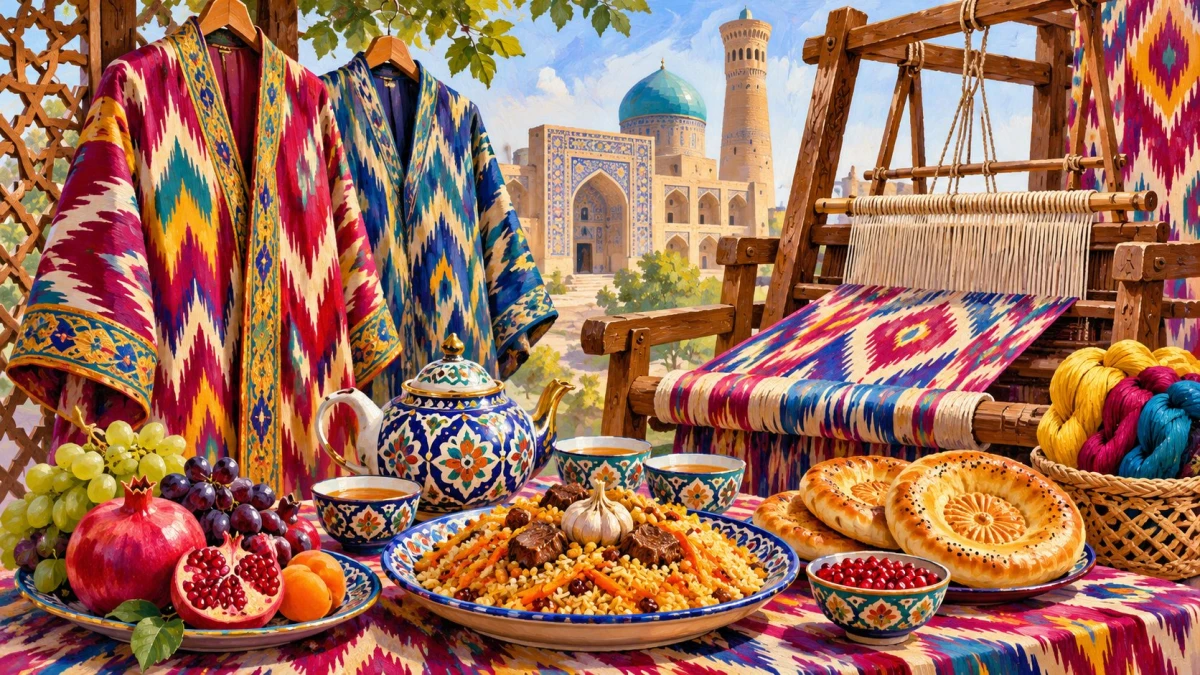
The first Bukharian Ikat Arts Festival, held Nov. 1 at Ashreynu in Astoria, showed museum dresses and jomas, held ikat art workshops and served Bukharian dishes.

This report was translated from Russian by Bukharian Jewish Post from coverage by The Bukharian Times.
The first Bukharian Ikat Arts Festival was held on Sunday, Nov. 1, at the Ashreynu center in Astoria, Queens. The program combined textiles from a Bukharian Jewish museum, hands-on art workshops and traditional food, and The Bukharian Times reported in its Nov. 5 issue that it brought together several generations.
The festival was organized jointly by Ashreynu, a Jewish community in Astoria, and the Yesodot foundation. According to the newspaper, it gave visitors a look at Bukharian Jewish life through textiles, cultural displays, art workshops and tastings. Ashreynu’s festival page lists the venue as 31-21 31st Street in Astoria. Bukharian Jewish Post previewed the event on Oct. 30.
Museum dresses and a private joma collection
The newspaper called the centerpiece of the day an exhibit and presentation of items from the Bukharian Jewish heritage museum in Rego Park, presented by Aron Aronov and Alla Aronova. Traditional Bukharian dresses and other garments made in the ikat technique were shown for their bright patterns, fine workmanship and cultural meaning, as clothing passed down through generations.
A private collection of Bukharian jomas, the traditional long robes, was also on display. The Bukharian Times wrote that, together with the museum pieces, the collection showed a connection to the history and identity of Bukharian Jews, Tajiks and Uzbeks, whose families carried these traditions from Central Asia to Queens.
Ikat is a resist-dyeing technique in which the threads are tied and dyed before weaving, so that the pattern appears as the cloth is woven. Similar techniques developed independently in several regions, including Central Asia, according to reference sources. Ashreynu’s announcement described Bukharian ikat textiles as “a window into the history, artistry, and cultural heritage of Bukharian Jewish communities.”
Workshops, food and the organizers
Studio Shoshan led interactive art workshops. According to the report, children and adults learned about the colors and patterns associated with ikat and made their own textile-inspired artwork. The newspaper said that by encouraging participants to make something with their own hands, the workshops made cultural preservation accessible and personal.
Food was a major part of the day. Mama Liza, whom Ashreynu’s announcement called “the famous Mama Lizachka,” introduced guests to traditional Bukharian dishes. The festival page had advertised savory and sweet Bukharian pastry samples.
Diana Rakhnaeva and her brother Daniel Rakhnaev, co-founders and chief executives of Yesodot, took part. According to the report, Diana Rakhnaeva spoke about Bukharian Jewish identity, the meanings carried by traditional garments and the responsibility to pass family and community traditions to the younger generation.
The newspaper also credited Ashreynu’s organizing team, including Stephanie Luxenberg and Ayelet Perl. It said Perl contributed to many parts of the event and helped bring artists, cultural historians and community members together.
Funding
The festival was supported by a Mesora Bridges grant from UJA-Federation of New York. The Bukharian Times described the grant as an initiative linking the Bukharian and other Jewish communities in Queens. The festival also received additional funding from the Queens Jewish Community Council and the New York City Department of Cultural Affairs. Ashreynu’s page lists the same three funders.
The newspaper concluded that the festival was “not just an exhibit of fabrics” but a demonstration of how heritage stays alive when people can see it, learn its stories, create something new from its patterns and share it with their neighbors. Photographs accompanying the report were credited to Alla Aronova.
Sources: The Bukharian Times, Nov. 5 report; Ashreynu festival page; Bukharian Jewish Post preview, Oct. 30; Wikipedia: Ikat.
What's Your Reaction?
 Like
0
 Dislike
0
 Love
0
 Funny
0
 Wow
0
 Sad
0
 Angry
0








Comments (0)