
David Mavashev Reviews Robert Pinkhasov's 800-Page History of Bukharian Jews: 'Not the Last Word, but a Foundation'
In The Bukharian Times, David Mavashev reviews Dr. Robert Pinkhasov's 'Bukharian Jews in the History of Centuries,' praising its archival scope and noting its encyclopedic limits.

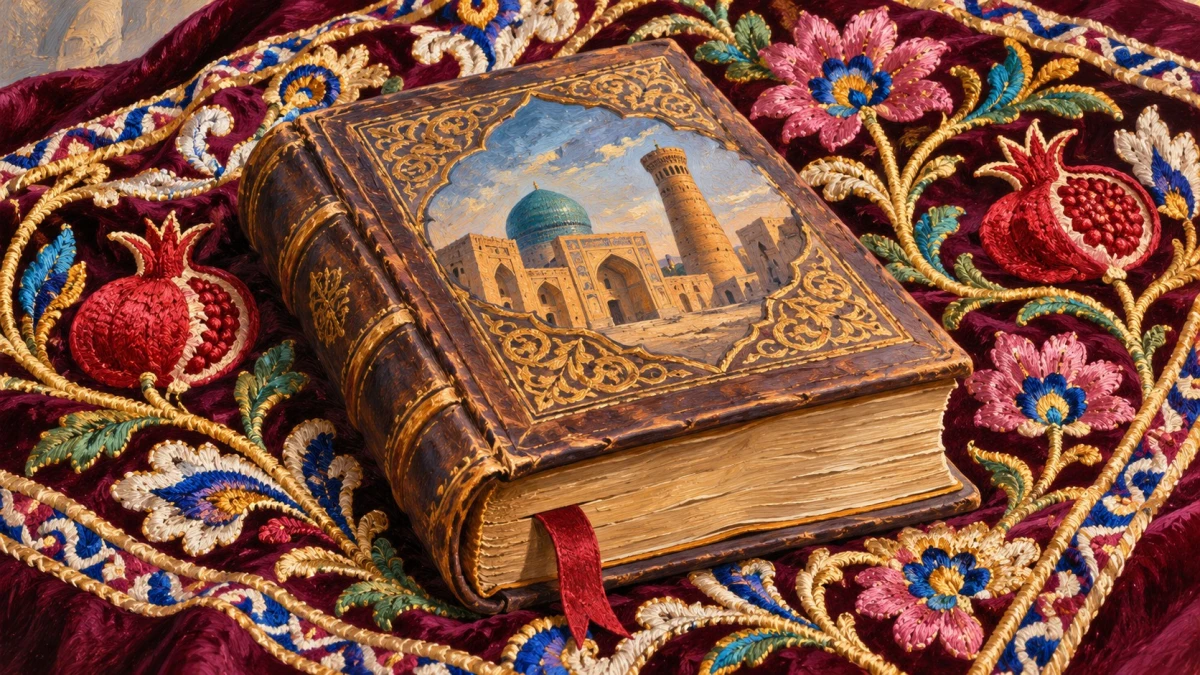
This report was translated from Russian by Bukharian Jewish Post from David Mavashev's review published in The Bukharian Times, No. 1292 (Nov. 12–18, 2026). Quotations are our translations.
David Mavashev, president of the Itzhak Mavashev Foundation, has published a long review of Dr. Robert Pinkhasov's book "Bukharian Jews in the History of Centuries," calling it a "fundamental work" and a large foundation for further research, while noting what he sees as the natural limits of a volume of its scale. The review, headlined "A Bridge Across the Centuries," appears in this week's issue of The Bukharian Times.
The book and its author
According to the review, the Russian edition of the book runs 813 pages and the English edition 783. Mavashev wrote that behind those numbers stand about a quarter-century of the author's work with archives, documents of the tsarist and Soviet administrations, metrical (civil registration) books, the pre-revolutionary press of Turkestan, memoirs, biographical materials and rare photographs. The book is dedicated to the memory of the author's parents, Abram Nisanovich and Frida Yurievna Pinkhasov, and to people who helped prepare and publish it.
The review gives the author's biography: Robert Abramovich Pinkhasov was born in 1937 in Tashkent and graduated from the Tashkent Medical Institute in 1960. He worked as a physician, taught urology and earned the Soviet degree of candidate of medical sciences. He has lived in the United States since 1992. He founded and leads the Roshnoi public research center and is the author of numerous research works and one of the compilers and authors of encyclopedic publications on Bukharian Jews, the review said.
Mavashev disclosed a personal connection: the author's father, Abram Nisanovich Pinkhasov, was a close friend of Mavashev's father, the scholar Itzhak Mavashev. He wrote that this makes him especially careful to separate his personal attitude toward the author from his assessment of the book.
What the book covers
According to the review, Pinkhasov begins the main historical section in the 17th century and traces the formation and development of Bukharian Jewish communities over the following centuries. Mavashev noted that Jewish presence in Central Asia is much older, and drew a distinction between the ancient history of the region's Jewish population and the gradual formation of the people with their own culture who later came to be called Bukharian Jews.
The book examines Jewish life in the Emirate of Bukhara, including legal status, restrictions, relations with the Muslim population, religious life, trade, education and culture, the review said. It gives separate attention to the chala, Jews forced to convert to Islam who in many cases secretly kept their ties to Judaism. Mavashev highlighted the book's treatment of Rabbi Yosef Maman Maghribi, who arrived in Bukhara in the late 18th century and whose work, the reviewer wrote, strengthened religious life and ties with other Jewish centers.
The book also contains information on 87 of the best-known Bukharian Jewish merchants and industrialists of the 19th century, according to the review, along with sections on family life, weddings, the position of women, clothing, jewelry, cuisine, holidays and customs. Mavashev wrote that such sections matter especially today, when many elements of the old way of life have disappeared.
Literature and a family story
Mavashev said the history of literature interested him most. The book discusses Shohini Sherozi, Imroni, Yusuf ben Yitzhak, Khoja Hakohen, Ragib, Zabikho, Malikho and other figures of the Judeo-Persian and Bukharian Jewish literary tradition, he wrote.
He recounted that his father studied the poet Shohin and wrote a dissertation about him. As Itzhak Mavashev used to tell it, he was asked to take a Tajik rather than a Jewish poet as his subject; he refused and did not defend the dissertation. The reviewer linked the episode to the atmosphere of the Soviet era, when the "fifth line" in a citizen's passport recorded nationality. Mavashev wrote that his father's interest began at home: his grandmother, Soro Mavasheva, gathered women and girls in her house, read them the works of Shohin and other Jewish poets and explained them.
Strengths and limits
Mavashev wrote that the book's scale is both its strength and its natural limit. Trying to cover several centuries, dozens of topics and the lives of more than 2,000 people gives the narrative an encyclopedic character in places, he said, and the analysis of broader historical processes sometimes recedes behind names and biographical details. He added that not every topic could receive equally deep treatment and that some dates, assessments and interpretations may be debated.
He noted that Pinkhasov himself does not claim to be definitive and writes that the book does not cover every question of Bukharian Jewish history, religion, tradition and culture. "It is more correct to see it not as the last word, but as a large-scale foundation for further research," Mavashev wrote.
Sources: The Bukharian Times, "Мост через столетия" (A Bridge Across the Centuries), by David Mavashev, No. 1292, Nov. 12, 2026, https://bukhariantimes.org/most-cherez-stoletija/
What's Your Reaction?
 Like
0
 Dislike
0
 Love
0
 Funny
0
 Wow
0
 Sad
0
 Angry
0






Comments (0)