
'Unbroken,' a Documentary on Jewish Wartime Evacuees in Uzbekistan, Screens at Harlem's Voices Rising Festival
Vyacheslav Shatokhin and Elina Greypel's film screened Nov. 8 at the Harlem School of the Arts; Shatokhin hopes for an evacuation museum honoring Uzbeks, Tajiks and Bukharian Jews.

This report was translated from Russian by Bukharian Jewish Post from an article by journalist Marina Logunova in The Bukharian Times, No. 1292 (Nov. 12–18, 2026). Quotations are our translations.
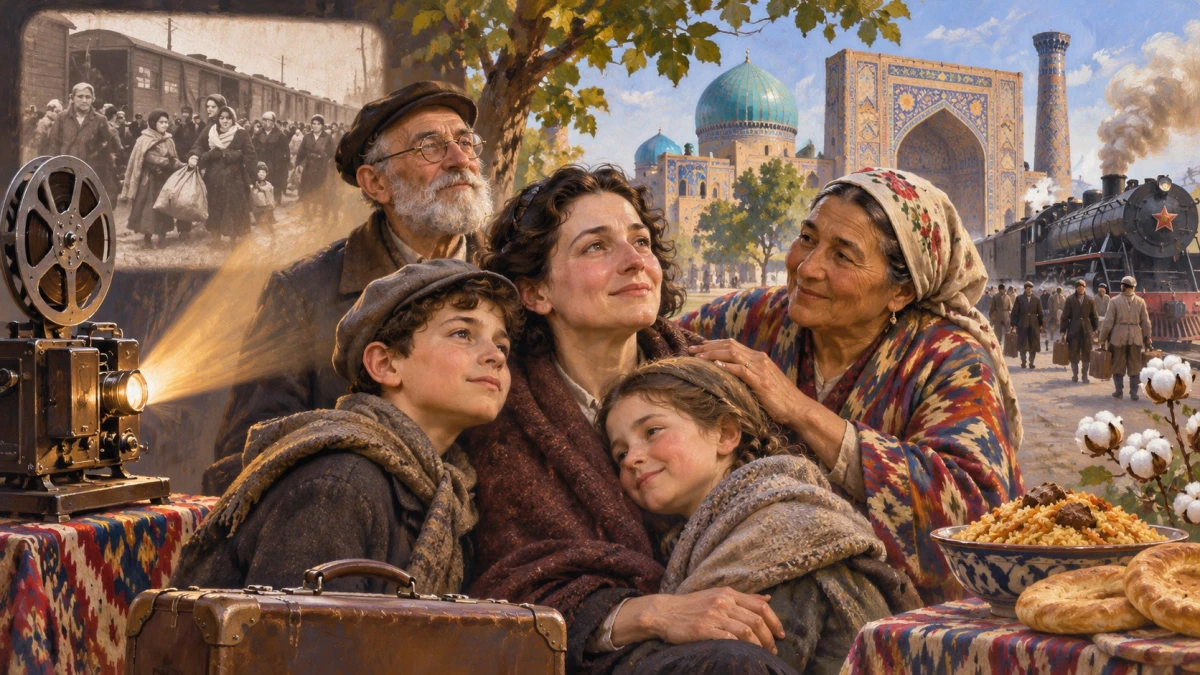
NEW YORK — "Unbroken," a documentary about Jewish refugees who were evacuated to Uzbekistan during World War II and the local families who took them in, was screened on Nov. 8 at the Voices Rising independent film festival at the Harlem School of the Arts, The Bukharian Times reported. One of its creators told the audience he hopes to help establish a museum of the evacuation in Uzbekistan that would honor the Uzbek and Tajik peoples and the Bukharian Jews who opened their homes to refugees.
The festival and the film
According to the report by journalist Marina Logunova, who attended the screening, the festival presented 11 films chosen through a selective process from authors in different cities and countries. Their subjects included fate, family relationships, mental health, violence, finding one's place in society, attention-deficit/hyperactivity disorder, the diagnosis and prescription of antidepressants, women who wear the hijab and those who refuse it, teenagers who go missing after dangerous situations, and domestic violence.
"Unbroken" was made by Vyacheslav Shatokhin and Elina Greypel, Russian-speaking filmmakers who presented their work to an American audience, the paper said. It described the film as "a story of humanity, gratitude and rescue" and reported that the audience received it warmly.
The film is built in large part on interviews Shatokhin filmed in 2017 for Nabi Rakhkhakov's film "The Last Summer of Childhood," according to the report. It takes viewers back to the war years, when thousands of people, among them Jews and members of other nationalities, were forced to leave their homes and were evacuated to Tashkent and other cities of Uzbekistan, where they found safety. Local residents, themselves living through hard times, gave the refugees shelter in their homes and shared what they had, the paper said. Decades later, the people interviewed in the film thank the people of Uzbekistan with tears in their eyes.
The report said a particularly emotional moment came when Greypel sang "A Yiddishe Mame" as part of the program, and that many in the audience were moved to tears. The audience applauded for a long time after the screening. The filmmakers, the author of the article and some of the people who appeared in the film as children were invited to speak and to answer questions.
"I have been working on this project for 16 years"
"I have been working on this project for 16 years," Shatokhin said, according to the paper. He said several documentaries have been made over those years on the evacuation of Jewish refugees from the western regions of the Soviet Union to Central Asia, and to Uzbekistan in particular. "We hope that in Uzbekistan we will be able to create a museum of the evacuation and thereby pay tribute to the Uzbek and Tajik peoples, as well as to the Bukharian Jews, who opened wide the doors of their houses and apartments to receive the refugees," he said.
Margarita Levieva, the daughter of Roza Remenik-Levieva, said she was glad the story had reached American viewers through the festival. She described her own family's history: her grandfather, Abram Remenik, was killed in the defense of Odessa in 1941, and her grandmother, Shlima Bukhmil-Remenik, was evacuated to Tashkent with two children. Her mother grew up in an orphanage and told the family many stories about the evacuated families of European Jews, she said.
A synagogue building in Kagan
Rafael Nektalov, editor-in-chief of The Bukharian Times, recalled that Shatokhin's projects had not always come together easily. "But being a principled, determined person, he was able to move this project forward," Nektalov said, according to the report.
Nektalov said Shatokhin had traveled with him to the town of Kagan in the Bukhara region. There, together with Israel's ambassador to Uzbekistan, Gideon Lustik (as spelled in the Russian original), the head of the Bukhara region's tourism department, Botyr Shakhriyorov, and the town's hokim (mayor), Mirshakar Turaboev, they visited the surviving building of a two-story brick Ashkenazi synagogue built in the 1890s. According to Nektalov, the building is officially included in Uzbekistan's national register of protected monuments, and a museum of the evacuation of European Jews and a tolerance center may be created there.
The article closed with the line that gave it its headline: "The voices of witnesses must be heard." It said that when eyewitnesses share their memories, history stops being a set of dates in a textbook and takes on a human face.
Sources: The Bukharian Times, "Голоса свидетелей должны быть услышаны" (The voices of witnesses must be heard), by Marina Logunova, No. 1292, Nov. 12, 2026, https://bukhariantimes.org/golosa-svidetelej-dolzhny-byt-uslyshany/
What's Your Reaction?
 Like
0
 Dislike
0
 Love
0
 Funny
0
 Wow
0
 Sad
0
 Angry
0









Comments (0)