
Tashkent Fund Reports Restoration of the Tekstil and Chigatai Jewish Cemeteries at Its Annual Evening, Where Aron Aronov Says 'We Did Not Run From the Uzbeks'
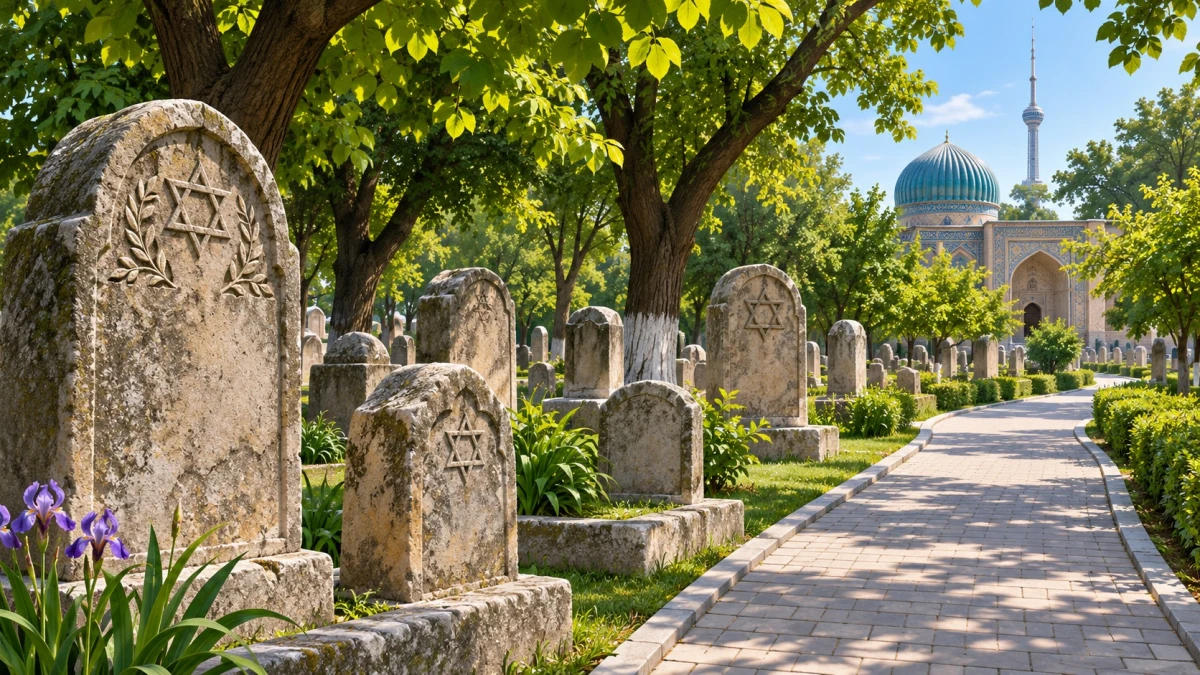
At its Nov. 12 charity evening, the Tashkent Charitable Foundation showed a film on restoring Tashkent's Tekstil and Chigatai Jewish cemeteries: more than 100 headstones, 400 inscriptions translated, new paving, trees and cameras. Aron Aronov spoke on memory.

This report was translated from Russian by Bukharian Jewish Post from the Kaykov TV video "Charity Fund Tashkent 11.12.2026" and three Kaykov TV clips of Aron Aronov's remarks at the same evening, published Nov. 16–17, 2026. Background is drawn from the fund's website and earlier reporting in the Bukharian Jewish Link. Quotations from the videos are our translations of the Russian.
The Tashkent Charitable Foundation, a fund run by Bukharian Jews from Tashkent who now live abroad, presented an account of its restoration work at the city's two Jewish cemeteries, known as Tekstil and Chigatai, at its annual charity evening on Nov. 12, 2026, according to videos of the event posted by Kaykov TV.
The fund's report film, posted on Kaykov TV's YouTube channel on Nov. 16, listed the work completed at both cemeteries. Aron Aronov, the founder of the Bukharian Jewish Museum in New York, spoke at the evening about memory and the homeland.
A fund for two cemeteries
The foundation, whose full name on its website is the Tashkent Charitable Foundation named after David Aminov, says it thanks "all Tashkent natives and their families" for helping with improvement works at the cemeteries of Tashkent. It appeals to people "regardless of the state or country" where they live, naming Austria and Israel among them, to support the work.
According to the report film's narration, the fund began its work more than 15 years ago, and 16 years ago it decided to carry out a major restoration of the Tekstil and Chigatai cemeteries. "Many sections of these cemeteries needed repair," the narrator says. "Dilapidated monuments, walls, gates and utility lines needed to be restored." The fund's website records earlier stages of the work, including a new building at Chigatai in 2013 with a room for the ritual washing of the dead, the restoration of 246 graves that year, and the translation of inscriptions on 304 graves from Aramaic in 2014.
Earlier reports in the Bukharian Jewish Link, in 2022, described the fund as part of a wider network of regional funds set up by the American Bukharian community to look after dozens of Bukharian cemeteries left behind in the former Soviet republics. One of those reports quoted the fund's president, Alik Babakhanov, as saying that about 7,000 former Tashkent residents live in New York.
What was done at Tekstil
According to the film, 26 trees were planted on the street outside the Tekstil cemetery, a canopy was put up in front of the gates, and the gates were painted. More than 600 square meters of paving stones were laid. Inside, a new canopy, a table, chairs and benches were installed, along with two air conditioners. Repairs were made to the memorial room, which the narration calls the "khanakoh," and to the doors of the storeroom, service rooms and restroom.
The film says special attention was given to restoring the monument to participants in the Great Patriotic War, the Soviet name for World War II. Trees, flowers and about 20 meters of curbing were added beside it, together with an 18-meter granite cascade. Forty-nine flower planters were placed around the grounds, more than 40 trees were planted around the perimeter, and 26 headstones were restored.
What was done at Chigatai
At Chigatai, the narration lists 1,500 square meters of paving stones, more than 70 flower planters, three air conditioners, the restoration of a wall, the painting of walls and gates, and the replacement of more than 150 meters of electrical wiring. More than 100 trees were planted and more than 100 headstones were restored. The film says the children's section of the cemetery was fully reconstructed and that inscriptions on 400 headstones were translated from what the narration calls ancient Aramaic. A water line was laid around the entire perimeter, water tanks were installed, and the World War II monument there was also restored.
For security, the film says, four surveillance cameras and four solar-powered lamps were installed, along with 10 trash bins and a 50-meter dividing fence. QR codes placed around the perimeter link visitors to the fund's website. The narration adds that the fund holds a charity evening every year to report on its work and that its leaders often visit Uzbekistan to inspect the cemeteries and meet with officials.
Visitors interviewed in the film thanked the fund. "My mother is buried in this cemetery, and many relatives," one woman says. "I see a huge difference between what was and what is now." Another visitor said cemetery workers helped his family quickly find the graves they were looking for "with the help of the book." The fund's motto, repeated in the film, is "Without the past there is no future."
Aronov: "We did not run from the Uzbeks"
Aronov, whom Kaykov TV describes as a linguist who speaks 10 languages, addressed the question of why Bukharian Jews who left Uzbekistan as refugees keep going back. "Ninety percent of Bukharian Jews received refugee status," he said in a clip posted Nov. 17. He said that in Uzbekistan, unlike in Russia and Ukraine, there were no pogroms, and that Jews lived with Uzbeks on friendly terms. "We did not run from the Uzbeks, not from the Tajiks," he said. "We left the communist system."
In a second clip, Aronov read a poem by a Bukharian Jewish author addressed to Uzbekistan, which includes the line "By nationality I am a Jew, but by nature I long ago became an Uzbek." In a third, he spoke about the duty to remember the dead. "A person dies twice," he said, the second time "when he is forgotten." When visitors go to the cemetery and say the names of their ancestors, he said, "we are saying: dear ones, we have not forgotten you." He thanked "Alik and his team" for the work.
The videos do not say where the evening was held or how much money was raised.
Sources: Kaykov TV, "Charity Fund Tashkent 11.12.2026," Nov. 16, 2026, https://www.youtube.com/watch?v=9uyDbQBDX4Y ; Kaykov TV, Aron Aronov clips, Nov. 16–17, 2026: https://www.youtube.com/watch?v=aPUHCpCTgFQ , https://www.youtube.com/watch?v=s0sH2mNJE88 , https://www.youtube.com/watch?v=k24sFcZrz1M ; Tashkent Charitable Foundation named after David Aminov, https://fundtashkent.org/ and https://fundtashkent.org/about/ ; Bukharian Jewish Link (Russian section), "Сюда не зарастёт народная тропа," Dec. 2022, https://bukharianjewishlink.com/index.php/more/russian-section/4606-2022-12-07-12-33-27 ; Bukharian Jewish Link (Russian section), "И память, и долг, и умиротворённая душа!," June 2022, https://bukharianjewishlink.com/index.php/more/russian-section/4286-2022-06-15-19-26-37
What's Your Reaction?
 Like
0
 Dislike
0
 Love
0
 Funny
0
 Wow
0
 Sad
0
 Angry
0








Comments (0)