
On Kaykov TV, New York Photographer Emin Kuliev Plays AI-Generated Songs in Bukhori and Says His Profession Has Only a Few Years Left
In a Kaykov TV interview released Nov. 2, wedding and street photographer Emin Kuliev described 25 years behind the camera and played AI-made songs in the Bukharian Jewish language.

This report was translated from Russian by Bukharian Jewish Post from a Kaykov TV video interview and its published description.
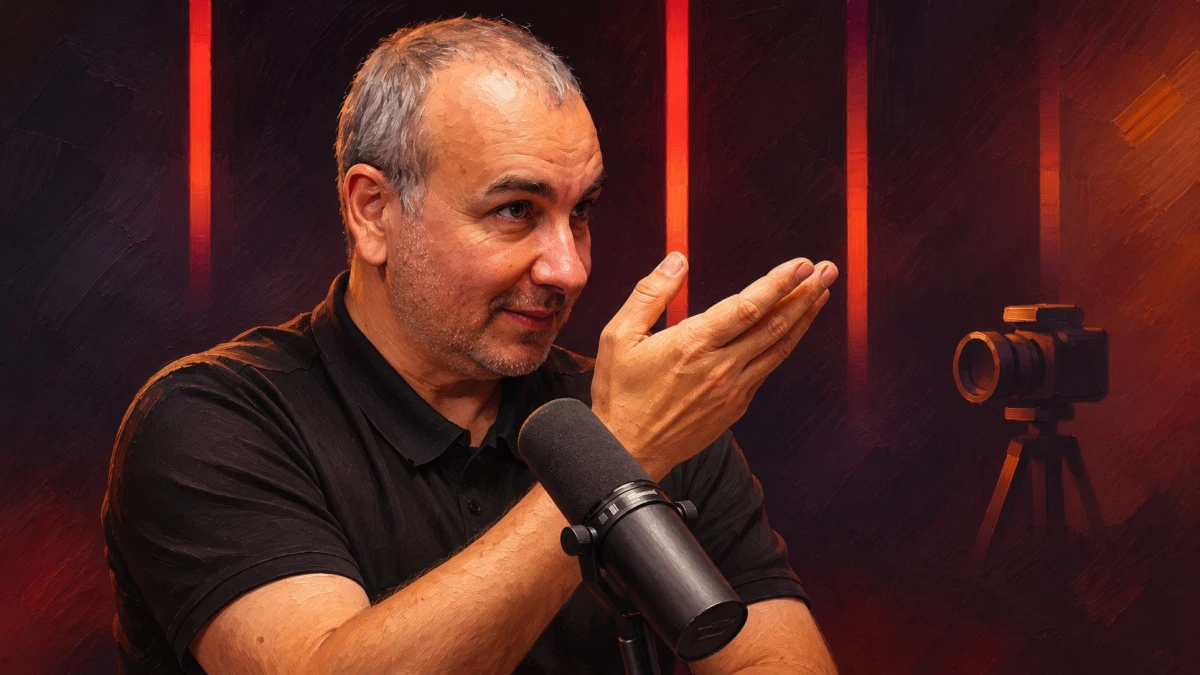
Emin Kuliev, a New York wedding and street photographer with 25 years of experience, told Kaykov TV host Roman Kaykov that artificial intelligence will transform his profession within a few years, and then used the studio to demonstrate songs in the Bukharian Jewish language that he had generated with AI. The 46-minute Russian-language episode premiered on Kaykov TV’s YouTube channel on Monday, Nov. 2, after two short promotional clips released the same day.
Kaykov TV, which describes its programming as interviews, stories of notable people, Bukharian Jewish culture, art, traditions and conversations about the future, introduced Kuliev in the episode description as “a well-known New York street and wedding photographer.” According to the description, the conversation covers his childhood in Baku, his move to the United States, his difficult path into photography and a car accident that changed his life.
From medicine to the camera
Kuliev said he was drawn to images from childhood, drawing in the back of the classroom and slipping out of school to watch films. He first chose a medical track in college because it promised a secure job, he said, but after clinical rotations in a hospital he switched his major to art, knowing it meant the uncertain life of a freelancer. He said years of working in sales, reading customers as they walked in, later helped him anticipate how people would behave at weddings.
The turning point, he said, was a serious car accident that left him with many injuries and nearly a year of recovery. Shortly before it, in 2002, he had bought a Canon G2 digital camera, the episode’s chapter list notes. Unable to go far, he photographed at home, experimenting with backgrounds, tripods, flash and light, and shooting musicians, actors, dancers and rappers.
One photographer, 200 guests
Kuliev said that over his career he never hired a second photographer for a wedding, even at events of 200 guests. In a promotional clip, the channel summed up his philosophy: once you understand that everything depends only on you, completely different possibilities open up. He said he was influenced in the early 2000s by wedding photojournalism that captured moments rather than posed shots, and recalled a wedding at which his camera’s shutter failed after three frames and his backup camera’s battery was low, forcing him to switch it on only for each shot. After that, he said, he always carried a handful of spare batteries.
He told Kaykov he shot relatively few weddings, roughly 12 to 15 a year, and found clients through word of mouth without advertising. Today, he said, guests photograph everything on their phones, and in many cases the result is enough for them. He described photographing a dog parade where, he said, he could not find a single camera among about a thousand spectators, only phones.
“Three to five years”
Kuliev said that when he first saw AI image generators two or three years ago, their results were crude, but he concluded that he had perhaps three to five years before generated images became indistinguishable from photographs. He said he tests the newest models every few days, that he can no longer tell real portraits from generated ones, and that he began photographing the streets of Manhattan intensively about three years ago, since events on the street are, in his view, the last place where reality can be documented. He described a technique of shooting “blind” with a 35-millimeter lens, often on a monopod, without looking through the viewfinder. A clip from the interview carries his line, “If you can see it, it’s already too late to shoot.”
Songs in Bukhori
Toward the end of the episode, Kuliev played several songs from a speaker he had brought to the studio. He said he does not speak the Bukharian Jewish language at all, so he wrote lyrics in Russian, including lines about a journey from the Bronx to Queens, and had an AI tool render them as songs in Bukhori in the style of Shashmaqam, the classical music of Central Asia’s Jews. He said he generated about 200 versions and chose the best, and that he had earlier made a song for his mother’s birthday the same way, experimenting with styles from Vivaldi and Bach to Eastern music. His aim, he said, was to show that AI is not something distant but is already here.
Kuliev also said he was uneasy about what such tools mean for musicians, saying he felt he had taken away a piece of their livelihood. He closed with advice to young people: never give up.
Sources: Kaykov TV: Emin Kuliev full interview, Nov. 2, 2026 (in Russian); Kaykov TV: “One photographer at a wedding with 200 guests” clip; Kaykov TV: “If you see it, it’s already too late to shoot” clip; Kaykov TV channel.
What's Your Reaction?
 Like
0
 Dislike
0
 Love
0
 Funny
0
 Wow
0
 Sad
0
 Angry
0










Comments (0)