
Jerusalem’s Begin Heritage Center Schedules a Six-Hour ‘Little Bukhara – Then and Now’ Walk Through the Bukharian Quarter on Nov. 19
The Menachem Begin Heritage Center lists a Nov. 19 Hebrew-language walk through Jerusalem’s Bukharian Quarter, from Davidoff House to the market, the Mussayoff compound and the ‘Messiah’s Palace.’

This report was translated from Hebrew by Bukharian Jewish Post from listings by the Menachem Begin Heritage Center, LiveJLM and Makore.
The Menachem Begin Heritage Center in Jerusalem has scheduled a six-hour walking seminar through the city’s historic Bukharian Quarter for Thursday, Nov. 19, according to the center’s ticketing page. The program, titled “‘Little Bukhara’ – Then and Now,” runs from 9 a.m. to 3 p.m., costs NIS 100 and will be given in Hebrew by guide Simcha Shapira-Blangs (name transliterated from Hebrew).
The center lists the day as enrichment course No. 6487 in its continuing-education series for tour guides, under the heading of outdoor tours. The Jerusalem event sites LiveJLM and Makore also list it, at the same date, time and price, with a link to the center’s ticketing page.
The route
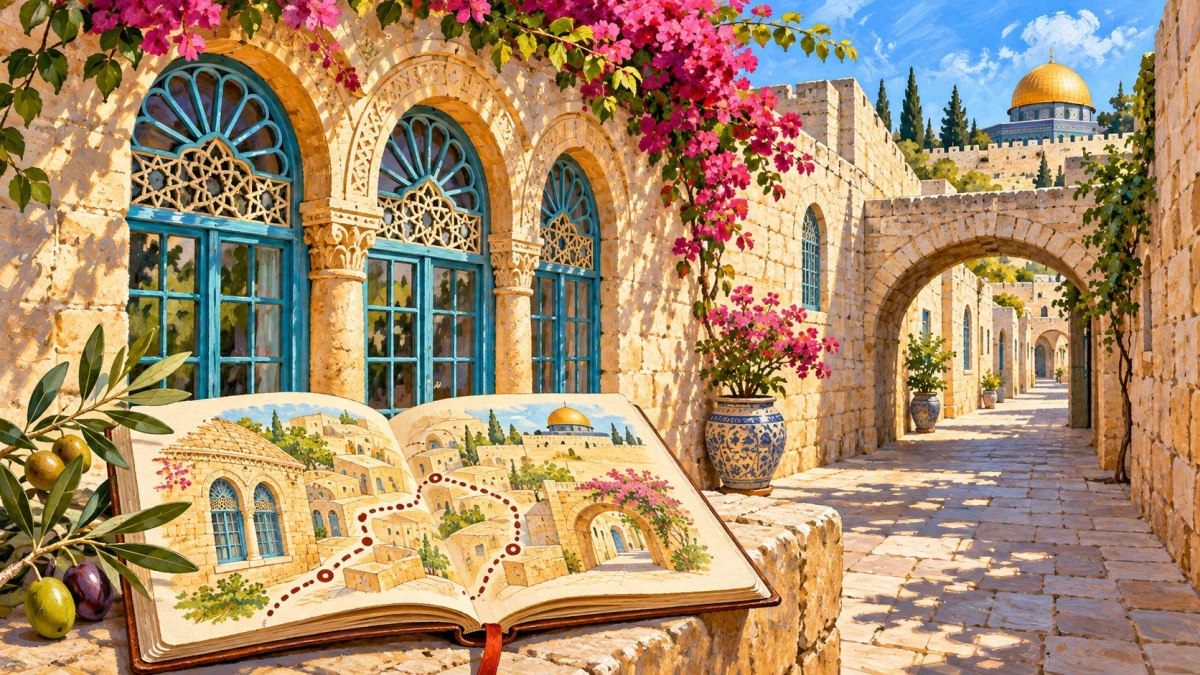
Participants are to meet at 10 HaBukharim Street, in the garden next to Davidoff House, and the walk ends at Kikar HaShabbat, the center says. Its description calls the Bukharian Quarter a neighborhood that was once called “the most beautiful of them all.” Among the mansions, the guide will tell the neighborhood’s unusual history and visit the Haj Adoniyahu courtyard and the Mussayoff compound. The listing promises a “cursed” bathhouse, an old and mysterious graffiti inscription, a satellite dish and the “Messiah’s Palace.” Along the way, it says, the group will look at how the area has changed and at its present-day Haredi character.
The published schedule is:
- 9 a.m.: opening and general introduction, covering the background to the founding of the quarter and Bukharian settlement in Jerusalem.
- 9:30 a.m.: the Maximoff house, the Mussayoff synagogue, the bathhouse and the local soup kitchen.
- 11:30 a.m.: the Bukharian market, with the story of the market and its merchants and an introduction to food stops that guides can build into tours there, including tastings.
- 12:30 p.m.: lunch break.
- 1 p.m.: the Davidoff House community administration, which the center describes as the neighborhood’s local visitor center.
- 1:30 p.m.: the Mashhadi houses, the synagogue of the Yazdi Jews and the Messiah’s Palace.
- 2:30 p.m.: the Tzfania Hotel, which the center describes as one of Jerusalem’s older hotels, decorated with a private Judaica collection.
- 3 p.m.: end at Kikar HaShabbat.
The center says the route is not wheelchair accessible and asks participants to bring water, comfortable shoes and lunch. Cancellations made up to 14 days before the date receive a full refund; later cancellations or no-shows are charged in full. The seminar requires a minimum number of registrants, and the center reserves the right to cancel it up to 72 hours in advance.
Background: the Bukharian Quarter
The quarter was founded by Bukharian Jews of Jerusalem’s Old Yishuv. In 1890, seven members of the community formed an association of Jews of Bukhara, Samarkand and Tashkent, which in 1891 bought land and set out a charter for a neighborhood built in the style of Europe’s major cities, according to Wikipedia’s account of the quarter’s history. The architect Conrad Schick designed it with streets far wider than Jerusalem’s main roads of the day and spacious mansions with large courtyards. The founders named it Rehovot, after the verse in Genesis 26:22, “For now the Lord has made room for us.” About 200 houses were built by the early 1950s, and most residents today are Haredi.
The “Messiah’s Palace” on the route is the Yehudayoff house, as Jerusalem’s Open House program also identifies it, known in Hebrew as the Armon, built between 1905 and 1914 by the Bukharian merchant Elisha Yehudayoff and his son-in-law, Yisrael Haim Hefetz. The Ottoman army used it as a headquarters in World War I. Davidoff House, next to the tour’s meeting point, was built in 1906 for Joseph Davidoff, housed the Hebrew Gymnasium high school from 1915 to 1925 and now serves as the quarter’s community center.
The quarter also has a link to the center’s namesake. In the early 1980s, Wikipedia notes, the neighborhood was included in Project Renewal, the urban revitalization program of Prime Minister Menachem Begin’s government, and was twinned with Johannesburg, whose Jewish community raised funds for its rehabilitation.
Bukharian Jewish Post reported on Oct. 18 that Jerusalem’s Open House festival offered tours of the Yehudayoff house and of a 1908 orphanage synagogue built by families from Bukhara. A separate two-hour public walk, “Between Bukhara and Jerusalem,” run by the tour company Jerusalem Out of the Box and listed on the iTravelJerusalem site, has remaining dates on Tuesday, Nov. 3, and Friday, Nov. 6, according to that report.
Sources: Menachem Begin Heritage Center, “‘Little Bukhara’ – Then and Now,” ticketing page (in Hebrew); LiveJLM event listing (in Hebrew); Makore event listing (in Hebrew); Wikipedia, Bukharan Quarter; Bukharian Jewish Post, Open House Jerusalem, Oct. 2026.
What's Your Reaction?
 Like
0
 Dislike
0
 Love
0
 Funny
0
 Wow
0
 Sad
0
 Angry
0




Comments (0)