
UK Supreme Court Reserves Judgment on Palestine Action Ban After 27 Arrests Outside and Jewish Groups’ Opposing Submissions

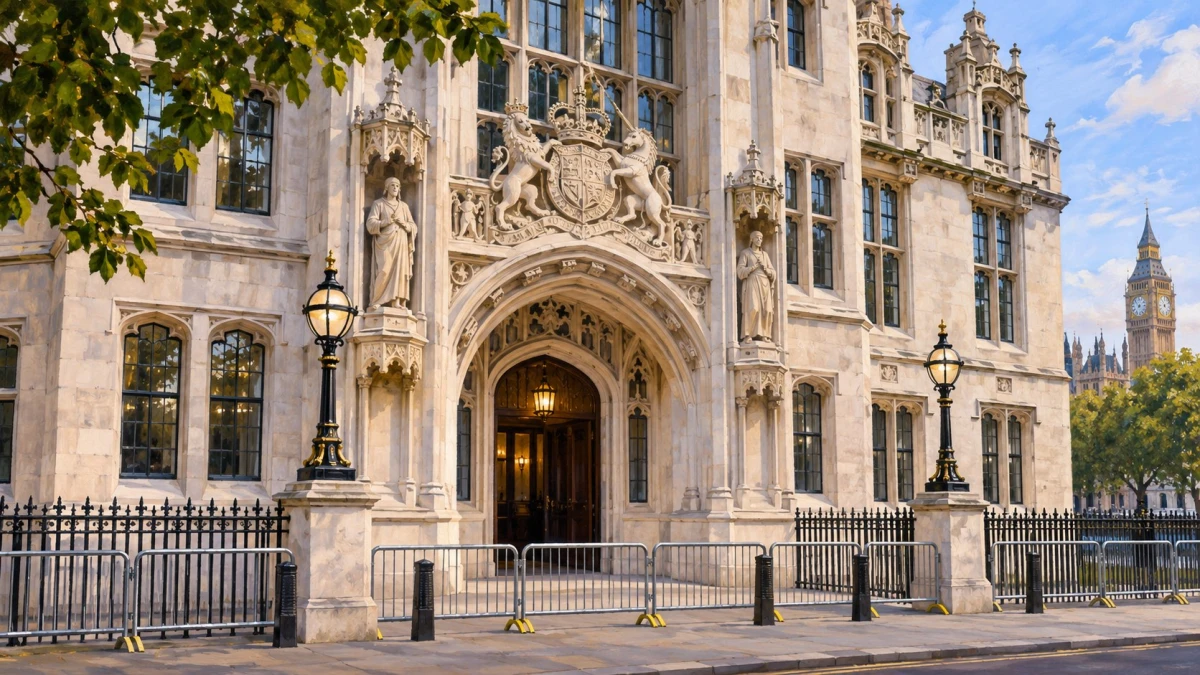
Britain’s Supreme Court has reserved judgment in Palestine Action co-founder Huda Ammori’s appeal against the government’s ban on the group under the Terrorism Act 2000. The two-day public hearing in London ended on Thursday, Nov. 5, 2026, and the case moved into closed proceedings on secret government evidence. On Wednesday, Nov. 4, the first day of the hearing, the Metropolitan Police arrested 27 people outside the court on suspicion of expressing support for a proscribed organization.
Instagram account @jewishbreakingnews posted video from outside the court on the evening of Nov. 5, Eastern Time. Its caption described a group of protesters it called “The Pink Keffiyeh Mafia” blocking traffic as police made arrests, and said one person arrested was a young man in a wheelchair. Bukharian Jewish Post confirmed the arrests and the court proceedings through the BBC, the Associated Press, The Jewish Chronicle, the Evening Standard and Middle East Eye. Those outlets did not describe the wheelchair arrest, so that detail rests on the post’s video.
Arrests outside the court
The Evening Standard reported that more than 20 demonstrators gathered outside the court before the hearing began on Wednesday, with officers carrying several people to nearby police vans. Several protesters held placards echoing an October post on X by journalist Sarah Helm, who is married to national security adviser Jonathan Powell: “God help us authors who support Palestine and Palestine Action.” Protesters replaced “authors” with words including “normal people,” “students” and “sons of Holocaust survivors.” Police took no action against Helm, The National reported. The National reported that actor Alfred Enoch attended the demonstration holding a sign that read “this is democracy not terrorism.”
“Officers have arrested a total of 27 people outside the Supreme Court on suspicion of expressing support for a proscribed organisation,” a Metropolitan Police spokesperson said, according to The National. Expressing support for the group carries a possible prison sentence of up to 14 years. Home Office figures seen by the BBC indicate more than 4,000 arrests at protests since the ban, with 1,200 charges authorized and those trials on hold until the court rules. On the previous Saturday, Oct. 31, police arrested 325 people at a pro-Palestine Action protest outside the U.S. Embassy in London, The Independent reported.
The arguments inside
The government banned Palestine Action in 2025 after activists broke into a Royal Air Force base that June, AP reported. In February 2026, three High Court judges found the ban unlawful. Five Court of Appeal judges overturned that ruling in June, finding the ban a “justified and proportionate” interference with free expression. The appeal was heard by Lords Reed, Sales, Lloyd-Jones, Briggs and Stephens.
For Ammori, Raza Husain KC argued that the group was banned on the basis of less than 1% of its actions. Only three of 385 incidents over five years were assessed as falling within the Terrorism Act definition, according to the BBC and The Jewish Chronicle. Henry Blaxland KC told the justices the ban had poured “fuel on to a fire.” The BBC reported that Ammori’s team accepted that Palestine Action could not be described as an ordinary peaceful protest group.
For the Home Office, Sir James Eadie KC said the group’s actions were “planned and undertaken secretly in order to avoid detection” and caused “serious damage to property,” Middle East Eye reported. He argued that serious property damage can amount to terrorism without violence against people and that the court should defer to Parliament’s decision. Lord Reed closed the public hearing by saying, “We will adjourn to consider the judgment we will give,” The Jewish Chronicle reported. No date has been set for the ruling.
Jewish groups on both sides
The case drew written submissions from Jewish organizations on opposite sides. For the Community Security Trust and the Jewish Leadership Council, Adam Wagner KC argued that the British Jewish community is “especially vulnerable to Palestine Action’s violent activities,” saying activists had attacked “Jewish charities and Jewish-owned businesses.” He warned that lifting the ban would “re-arm and revitalise a sinister and dangerous movement,” according to The Jewish Chronicle. The BBC reported Wagner’s argument that the group’s “crosshairs” had moved from defense firm Elbit Systems to “figures or institutions deemed by PA to be ‘Zionist.’”
Rachel Scott KC, for Jewish Bloc, a group of Jewish organizations that campaigns in solidarity with Palestinians, called that characterization a “fundamental misrepresentation of the underlying evidence.” She told the court that the Jewish Leadership Council and the Community Security Trust have no democratic mandate to speak for British Jews. Amnesty International UK, which opposes the ban, called the Nov. 4 arrests “another demonstration of the chaos” caused by the proscription.
Source: Instagram, @jewishbreakingnews.
View the original post on Instagram
Sources: @jewishbreakingnews post; BBC; AP; The Jewish Chronicle; Evening Standard; The National; Middle East Eye; The Independent; Amnesty International UK.
What's Your Reaction?
 Like
0
 Dislike
0
 Love
0
 Funny
0
 Wow
0
 Sad
0
 Angry
0









Comments (0)