
Labi Hovz: The Pearl Legend Behind Bukhara’s Landmark Ensemble
A Bukharian Times architecture feature retells the Nodir Devonbegi pearl legend and the 16th–17th-century building of Bukhara’s Labi Hovz pool-and-madrasa square.

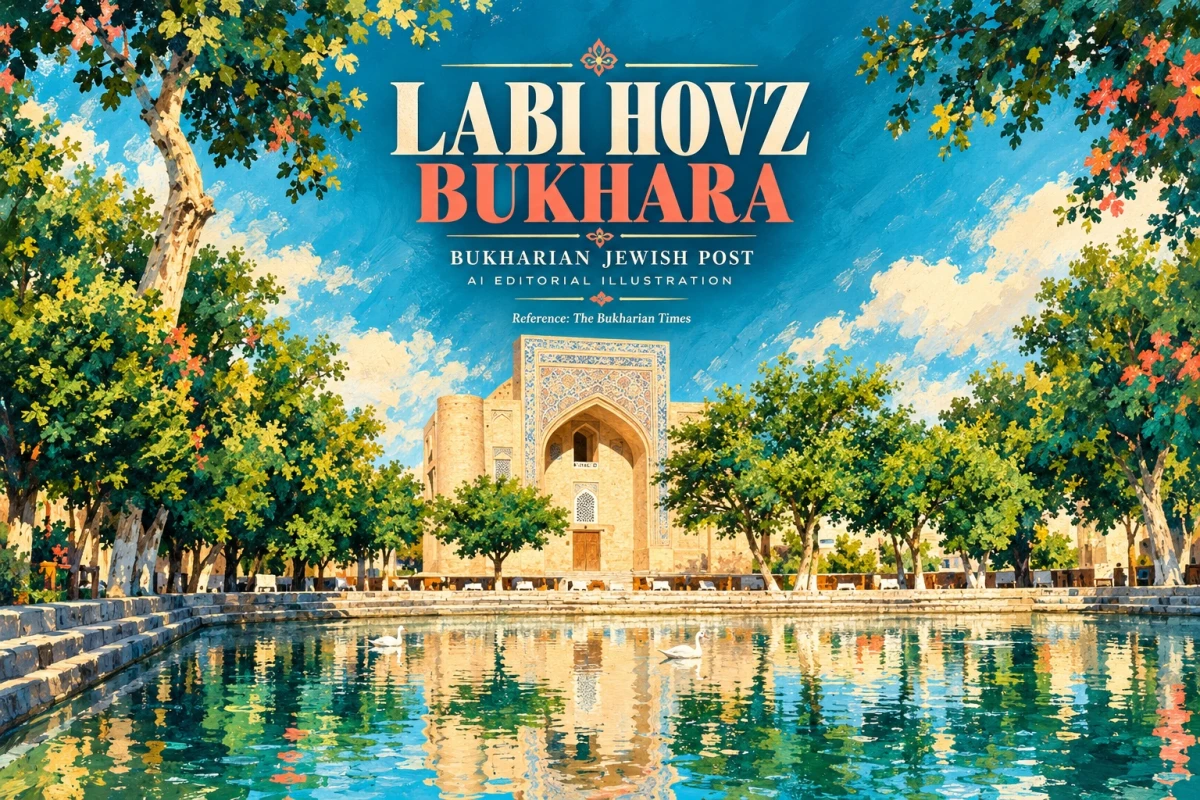
For travelers tracing Bukharian Jewish roots to the Silk Road city of Bukhara, Labi Hovz remains the city’s most photographed calling card: a brick-lined pool framed by madrasas and plane trees at the heart of the old town.
An English architecture feature published Oct. 15, 2026, by The Bukharian Times retells a beloved local legend. Nodir Devonbegi, grand vizier under Imam Quli Khan of Bukhara (r. 1611–1642), is said to have given his bride a modest pair of pearl earrings and later sold the pearls to fund a monumental building after she questioned their worth.
The article stresses that the ensemble’s documented history is older and more complex than the pearl tale. In 1568–1569, under the Shaybanids, Muhammad Qulbobo Kukaldosh built the Kukaldosh Madrasa—about 160 student cells—as a major regional school, forming the oldest core of the future square.
Between 1620 and 1623, Nodir Taghoybeg (Nodir Devonbegi) added a western khanqah for travelers and Sufis, excavated a large hovz (pool) measuring roughly 42 by 36 meters and about 5 meters deep, fed from the Shohrud canal, and completed the Nodir Devonbegi Madrasa on the eastern side. That eastern building began as a caravanserai; after Imam Quli Khan praised it as a “place of knowledge,” cells and a monumental portal were added to convert it into a madrasa. The portal’s rare figural decoration—stylized Simurgh birds and deer—is noted as unusual in regional Islamic architecture.
Today Labi Hovz sits at the center of Bukhara tourism itineraries that many Queens and Florida Bukharian families still visit when reconnecting with ancestral streets.
Sources: The Bukharian Times — “A Miracle Born of Pearls” (Dildora Ibrohimova).
What's Your Reaction?
 Like
0
 Dislike
0
 Love
0
 Funny
0
 Wow
0
 Sad
0
 Angry
0


Comments (0)