
“Laughing Burkho”: Remembering the Legendary Kayvonu of Bukharian Dushanbe
In The Bukharian Times, Tel Aviv musicologist Rafael Bangiev remembers Burkho Kikirova-Mataeva, the community cook, matchmaker and mourner known across Jewish Dushanbe.

Every Bukharian Jew in Dushanbe knew her house by the gates of the old market. In an essay published Oct. 1 in The Bukharian Times, Tel Aviv musicologist and writer Rafael Bangiev remembers Burkho Kikirova-Mataeva, known to the community as “Burkhoi Qiqir,” or “Laughing Burkho,” and remembered as a “woman-legend.”
She was a kayvonu. Bangiev stresses that a kayvonu was “not just a cook.” She knew the laws of kashrut, Jewish law and Bukharian tradition, and because she knew so many families, she could also act as a matchmaker.
A community that cooked for itself
Bangiev places her in the Bukharian Jewish community of Dushanbe, once part of Eastern Bukhara, whose roots he dates to the second half of the 19th century. According to Bangiev, the community built a synagogue close to the market in 1904 and owned a plot for a cemetery. (Dushanbe’s historic Bukharian synagogue was demolished between 2006 and 2008, and a new one opened in 2009.)
Families kept kashrut and held their celebrations at home, in their courtyards or in the synagogue, he writes. Ahead of an event they bought a calf and live chickens and called the rabbi and shochet from the synagogue. The women of the quarter then came together to clean the birds. No one in the community, he says, hired a non-Jew to cook, not even the finest chef.
A walk through her quarter
Bangiev takes readers on a short tour of the quarter by the entrance to Dushanbe’s old Putovsky market where Burkho lived. On the way, readers pass the workshop of the Alaev tinsmiths, Nataniel and his son Sasha, who made stovepipes. They also pass a trader in tripe and cow’s feet, an almost 100-year-old man nicknamed “Jurghot” (“Yogurt”) who liked to watch everything around him, and the shoemaker Ari Qanda, “Ari Sugar.” Ari’s house served market traders as a caravanserai, where they tied up their donkeys and camels.
Cook, matchmaker and mourner
Born into the respected Kikirov family, she married Nison Mataev, and she and her children took his surname. But the nickname stayed with her for life. Bangiev describes her as charismatic, strong-willed and fearless, but famous for her kindness and hospitality. She was the community’s chief kayvonu and ran its events, he writes, because her presence guaranteed order and success.
When there was no one else, she washed the dead before burial and served as a guyanda, a lamenter at funerals. She knew hundreds of the folk verses these women recite on such days. She never cared about payment, Bangiev writes. What mattered was “mitzvo-dusti,” a love of mitzvot. She and her husband raised seven children: Misha, Gavriel, Rakhamim, Mikhael, Svetlana, Sasha and Seryozha.
Bangiev also shares a family memory. When his brother Robert was born and their mother’s milk suddenly stopped, he writes, Burkho nursed the baby herself for a whole week.
A photo that traveled
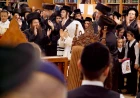
The essay also tells how her memory resurfaced. Bukharian Times editor Rafael Nektalov saw a photograph of her at work over a cooking pot on the Facebook page of her daughter, Svetlana Mataeva, who lives in Kiryat Gat. He then sent the photo to Professor Tatiana Emelyanenko of the Russian Museum of Ethnography, a researcher of Bukharian Jewish history and ethnography who collects photographs of the community.
Nektalov told Bangiev that she came from the Samarkand clan Tartibo, a name that means “order” in the Bukharian Jewish language. The essay also notes a book on the clan, A Tear of Memory: The Aminovs (Tartibo), by Nisim Aminov.
Bangiev ends by thanking Svetlana Mataeva, on behalf of the Dushanbe families who remember her mother, for keeping her name and good deeds from being forgotten.
This report was translated from Russian by Bukharian Jewish Post from an essay by Rafael Bangiev in The Bukharian Times.
Sources: Rafael Bangiev, “The Legend of Dushanbe: Burkhoi Qiqir Mataeva,” The Bukharian Times (Oct. 1, 2026, in Russian); Dushanbe Synagogue (background); Russian Museum of Ethnography staff page for Tatiana Emelyanenko.
What's Your Reaction?
 Like
0
 Dislike
0
 Love
0
 Funny
0
 Wow
0
 Sad
0
 Angry
0






Comments (0)